Generalized Universe Holography (GUH):
A Working Hypothesis
Generalized Universe Holography (GUH) is now available as a public preprint on Zenodo with a persistent DOI.
Canonical preprint (DOI): zenodo.org/records/18284647
Following the GUH preprint release, we have noticed conceptually related work emerging independently in adjacent domains — including boundary-first and non-local response frameworks that yield low-dimensional predictive structure. This mention is not presented as evidence for GUH, but as an example of parallel intuition: global boundary constraints → effective operators.
Example (galactic dynamics): A Fixed–Shape Gravitational Kernel with Baryon–Only Amplitude for Galaxy Rotation Curves
— referenced via an X discussion thread.
↗ View discussion / reference
my high school physics teacher.
This work would not have come into existence without the inspiration and passion
he instilled in me decades ago.
Keywords: holographic principle, quantum gravity, cosmology, emergent spacetime
GUH Documents
Canonical White Paper (Recommended)
Generalized Universe Holography (GUH): A Working Hypothesis for Emergent Spacetime
Zenodo preprint, January 17, 2026
⬇ View / Download (DOI)
Early Concept Note (Archival)
Generalized Universe Holography – Initial Hypothesis (v0.3)
January 4, 2026
⬇ Download (archival)
This earlier document is preserved for historical and conceptual context.
Latest revision is always available via the Zenodo DOI.
1. Introduction
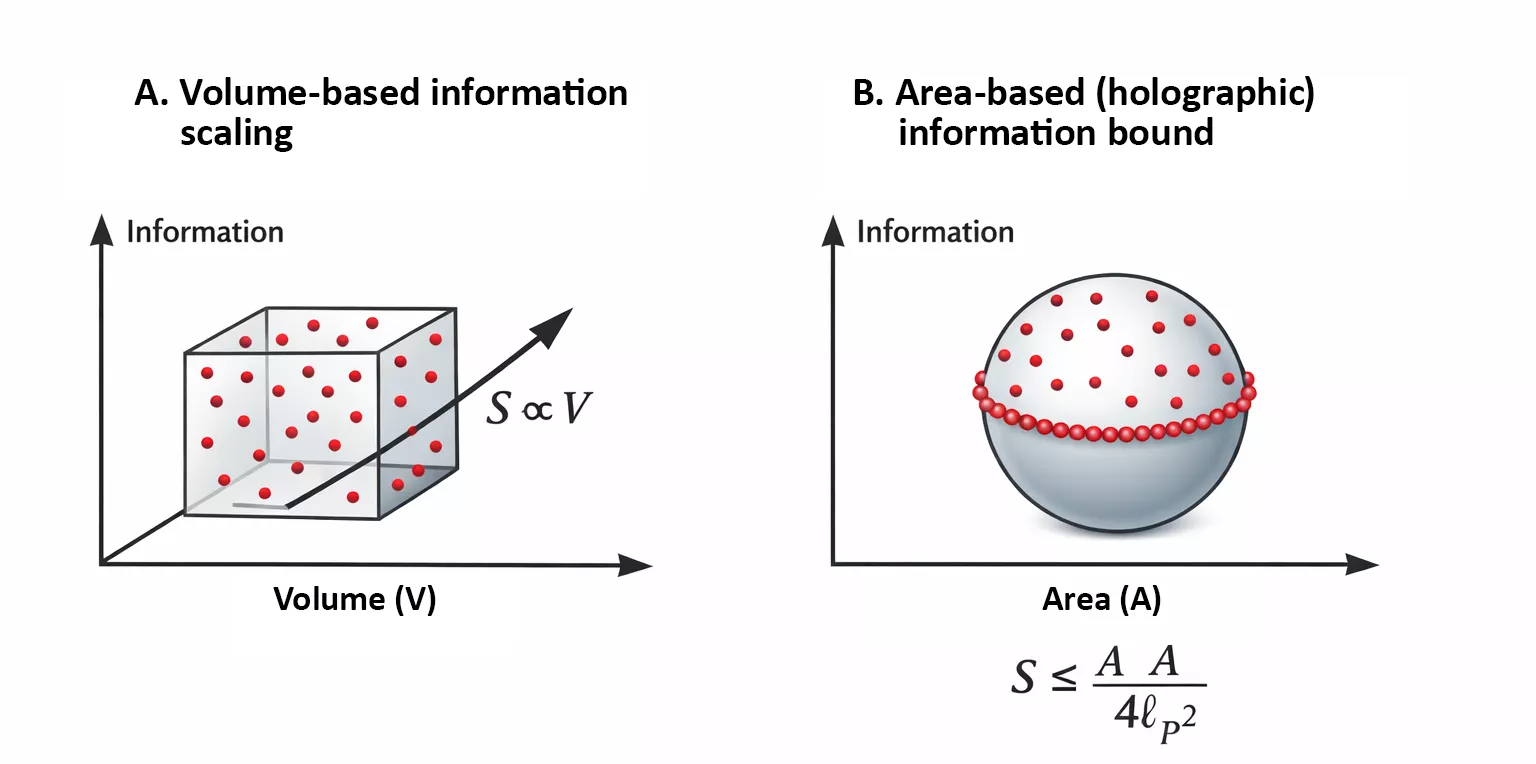
The holographic principle, first proposed by 't Hooft (1993) and Susskind (1995), states that the description of a volume of space can be encoded on its boundary surface, with information density bounded by the surface area rather than volume. This idea, formalized in the AdS/CFT correspondence by Maldacena (1998), has profoundly influenced quantum gravity research.
GUH generalizes this principle to cosmologies beyond AdS, including our observed ΛCDM universe. It suggests that apparent three-dimensional reality emerges from a two-dimensional “screen” at the cosmological horizon.
2. Foundations of the Holographic Principle
2.1 Black Hole Thermodynamics
Bekenstein and Hawking showed that black hole entropy is proportional to horizon area:
Mathematically, the entropy bound for a region of space is \(S \le (A/4)\) in Planck units.
2.2 AdS/CFT Correspondence
Maldacena demonstrated exact duality between gravity in Anti-de Sitter space (AdS) and conformal field theory (CFT) on its boundary:
3. Generalized Universe Holography (GUH) Hypothesis
Reproduced from the GUH Zenodo preprint (January 2026).
GUH proposes:
- The observable universe's degrees of freedom are encoded on a lower-dimensional boundary (cosmological horizon).
- Three-dimensional spacetime and matter fields emerge from quantum entanglement on this boundary.
- Gravitational dynamics arise from boundary quantum information evolution.
3.1 Mathematical Formulation
In GUH, the entropy of a cosmological region is bounded by its boundary area:
The emergent metric satisfies:
For de Sitter space, GUH extends dS/CFT with entropy:
4. Visual Representations
Conceptual models illustrating the transition from classical volume to holographic boundary.
5. Testable Predictions
- Potential patterns in the CMB power spectrum beyond standard ΛCDM (especially at low multipoles).
- Possible subtle deviations in gravitational-wave propagation over cosmological distances.
- Information-theoretic constraints on admissible cosmological histories.
6. Roadmap
- 2026–2027: Comparative reading + anomaly audit against public cosmology datasets and literature.
- 2027–2030: Phenomenological models enabling quantitative comparisons with observations.
- Long-term: Formalization of boundary-correlator → emergent-geometry mapping.